
Validation
Validation: Plate Fin Heat Sink
In this post, we present a validation case for the Vanellus conjugate heat transfer solver, using a plate fin heat sink to cool a transistor under forced convection. Our results are validated against a benchmark measured experimentally by Ventola et al., and later studied numerically by SimScale using their own version of OpenFOAM, the leading open-source CFD solver.
The Setup
This benchmark case represents one of the most common scenarios in electronics cooling: heat generated in an electronic component conducts into a heat sink, and is then removed by forced convection into the surrounding air.
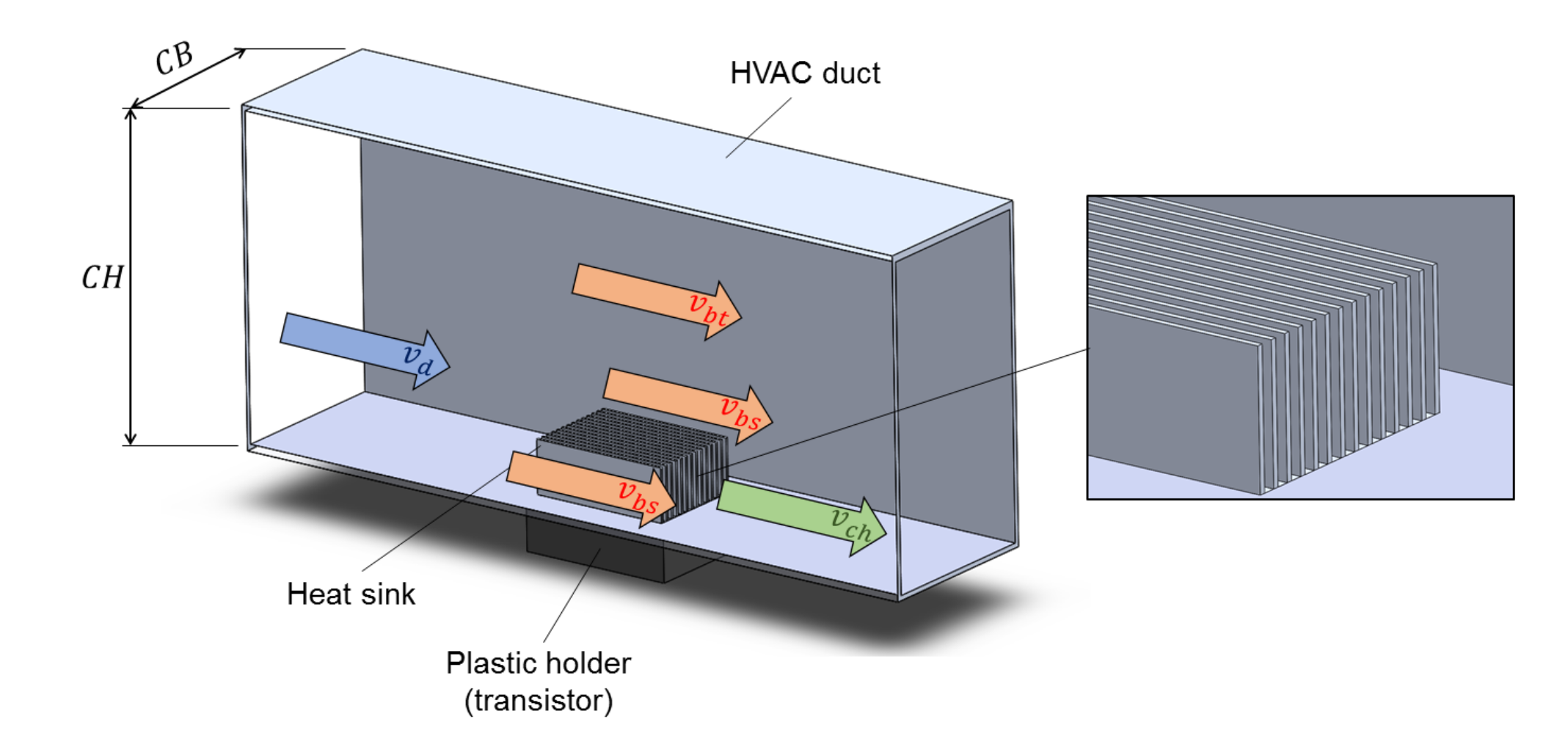
The case was originally presented by Ventola et al. (2016), and is pictured below. A MOSFET is placed in thermal contact with the bottom of an aluminum plate fin heat sink. The fins of the heat sink protude into an HVAC duct, such that all of the heat dissipation from the transistor must go into the duct. Air at ambient temperature is fed through the duct, passing over the fins of the heat sink and cooling it down.
Measurements
The experiments were designed to characterize the heat sink in a range of working conditions. Seven experiments were conducted, each one with different flow rates, transistor powers and ambient temperatures.
The effectiveness of the heat sink is characterized by the thermal resistance along the path from the transistor to ambient air. This is defined as \(R_{ja} = (T_j - T_a) / P\), where \(T_j\) is the transistor junction temperature, \(T_a\) is the ambient air temperature, \(P\) is the applied power to the transistor, and \(R_{ja}\) is the junction-to-ambient resistance.
The junction temperature, \(T_j\), is found by measuring the temperature at the interface of the transistor and the heatsink, \(T_i\), and applying the junction-to-case resistance of \(R_{jc} = 0.5\,\mathrm{K/W}\) for the specific model of the transistor to get \(T_j = T_i + R_{jc}P\).
Results
For each of the seven experimental setups, we ran a steady-state conjugate heat transfer analysis using the \(k\)-\(\omega\) SST turbulence model. We discretized the domains using our rectilinear mesher, including both the air in the duct and the heatsink, with an applied heat flux boundary condition to model the transistor. We used the SIMPLE algorithm to iterate toward the steady-state, and stopped iterating once the measured junction temperature had converged
We compared our results to both the experimental values in Ventola et al., and to a case study of the same problem conducted by SimScale. The SimScale CHT solver uses their own version of the OpenFOAM CFD solver, which is the most popular and trusted open-source CFD solver. The SimScale case differs from ours by using tetrahedral meshing rather than rectilinear, but otherwise also employs the same \(k\)-\(\omega\) SST turbulence modeling procedure.
The plot below shows the results of our parameter study, alongside the experimental results and the simulation results from SimScale. The first plot shows the junction temperature of the transistor, and the second plot shows the calculated junction-to-ambient thermal resistance. Each data point represents a different flow rate, ambient temperature and transistor power, as presented in Table 2 of Ventola et al.
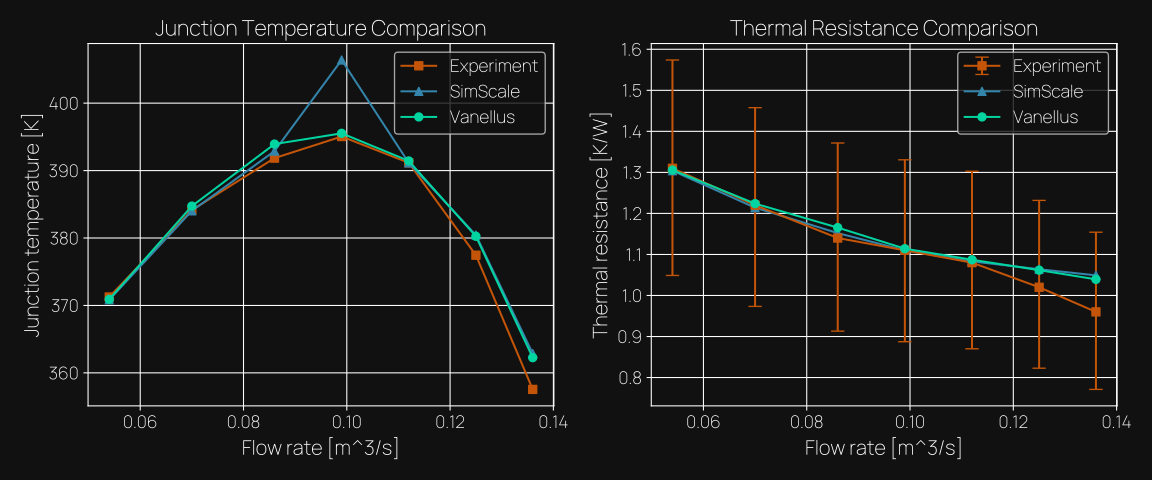
The results show the expected trend across the operating points. As flow rate increases: the thermal resistance decreases as the convective heat removal improves.
For the junction temperature, our results remain very close to the experimental values, and is much closer than the SimScale value for the \(0.099\,\mathrm{m^3\,s^{-1}}\) flow rate case.
For the thermal resistance results, all of the Vanellus results are well within the experimental margin of error, and are close to the results from SimScale.
To visualize the physics behind these numbers, below we show a snapshot of the velocity field for the \(0.125\,\mathrm{m^3\,s^{-1}}\) flow rate case, as well as the temperature field of the flow and heat sink.
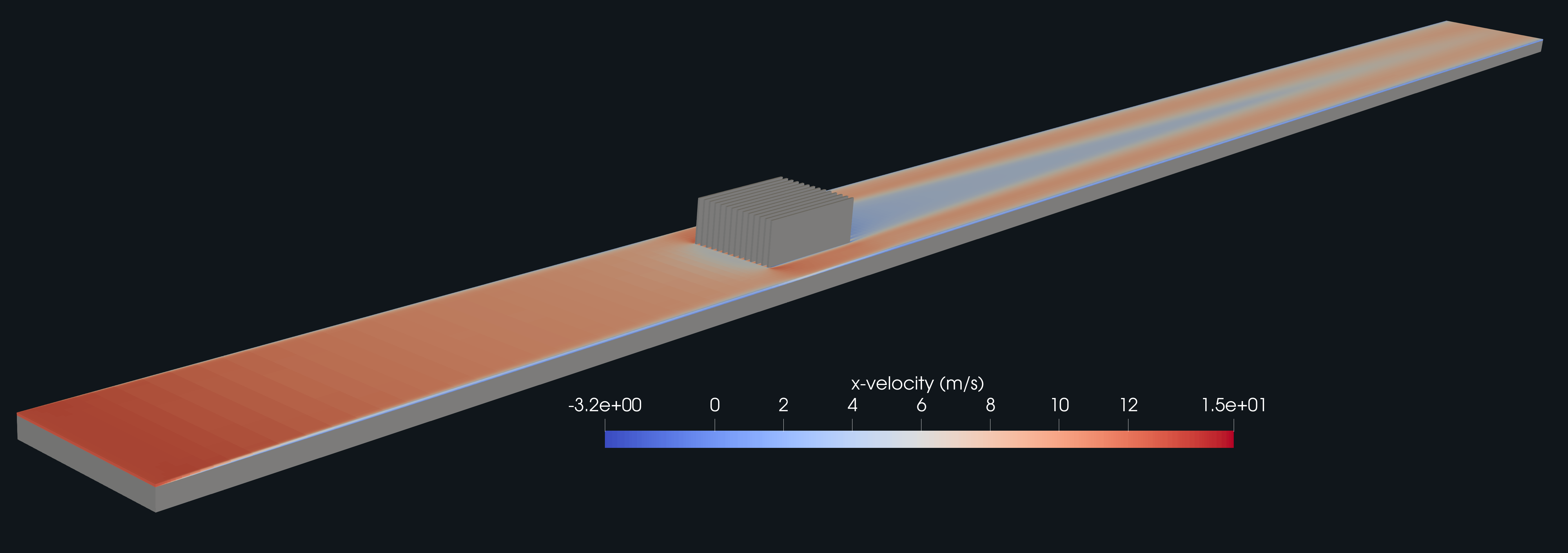
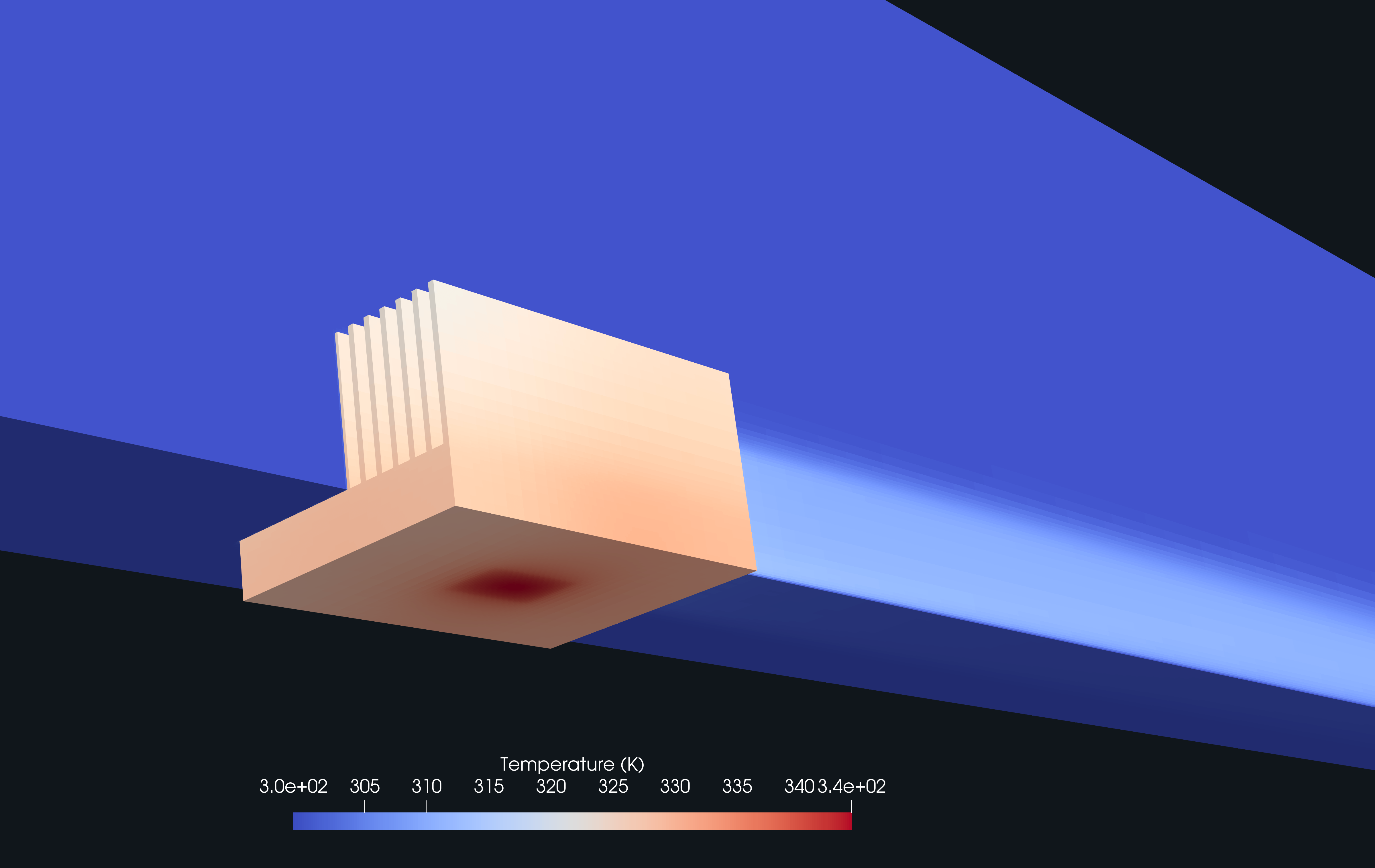
The velocity plot shows that the flow enters the heat sink through the fins, and causes a large wake region behind it. The corresponding temperature plot then demonstrates how the heat starts at the bottom of the heat sink, and is then conducted into the flow behind it, resulting in the cooling of the transistor.
Solver Performance
For this benchmark, we used our in-house automated rectilinear meshing pipeline to generate meshes for each case. The meshes were refined near the fins of the heat sink in order to resolve the turbulent boundary layers, giving an accurate value for the heat transfer. Although this meant remeshing for every case, each mesh took less than 0.1 seconds to generate this way. This demonstrates the advantage of our meshing approach over commonly used unstructured meshing approaches, which can take minutes to hours to generate per case.
The number of cells from each case varied from around 1.5 million to 2.5 million, increasing with the flow rate. The simulations were run until the junction temperature values converged, which required no more than 1000 iterations per case.
Running all seven cases in this parameter study one after another took under 8 minutes on an NVIDIA RTX Pro 6000 Blackwell GPU. In comparison, using traditional CPU-based CFD solvers, parameter studies of this size would be expected to take hours to complete.
Conclusion
By comparing against both experimental and industry-standard CFD values, we have proven the accuracy of our CHT modeling tool in a representative electronics cooling scenario. In the process, we have demonstrated that our GPU-accelerated solver allows for rapid operating-space exploration, extracting both flow field data and important component-level quantities such as the thermal resistance.
References
- Ventola, L.; Curcuruto, G.; Fasano, M.; Fotia, S.; Pugliese, V.; Chiavazzo, E.; Asinari, P. "Unshrouded Plate Fin Heat Sinks for Electronics Cooling: Validation of a Comprehensive Thermal Model and Cost Optimization in Semi-Active Configuration", Energies 2016, 9(8), 608. https://doi.org/10.3390/en9080608
- SimScale, "Conjugate Heat Transfer in Rectangular Fins", https://www.simscale.com/docs/validation-cases/conjugate-heat-transfer-rectangular-fins/