
Validation
Validation: Natural Convection
In this post, we present a validation case for the Vanellus convective heat transfer solver, using a differentially heated box. Our results are validated against a benchmark measured experimentally by Betts & Bokhari (data available here), and studied numerically by SimScale using their own version of OpenFOAM, the leading open-source CFD solver, and by Zhang et al. using Ansys Fluent, one of the most widely-used and highly-trusted commercial CFD softwares.
The Setup
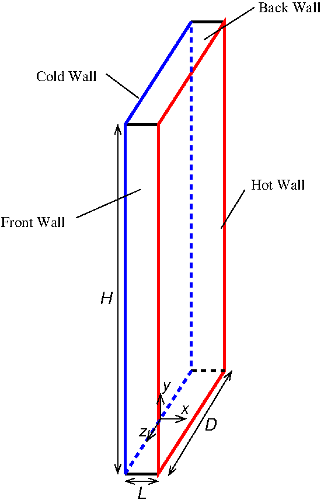
This benchmark is a prototypical case of natural convection. A tall rectangular cavity (pictured below) is differentially heated on it's two largest faces, with a temperature differential of 19.6°C. The remaining walls are kept insulated. The difference in temperature between the two faces drives a quasi-2D circulating flow inside the cavity, with the flow at the core of the cavity being fully turbulent.
Results
The experimentalists used temperature probes and laser particle-tracking to measure the temperature and vertical velocity along the centerline of the box (\(y=0\) in the above diagram).
We ran a steady-state convective heat transfer analysis using the \(k\)-\(\omega\) SST turbulence model. We discretized the domains using our rectilinear mesher, with fixed temperature hot and colds walls. We used the SIMPLE algorithm to iterate toward the steady-state, and stopped iterating once the temperature profile across the box had stabilised.
We compared our results to the experimental values in Betts & Bokhari, a case study of the same problem conducted by SimScale, and an equivalent \(k\)-\(\omega\) SST simulation performed in Ansys Fluent by Zhang et al.. Both the SimScale and Ansys Fluent codes use unstructured meshes in contrast to our rectilinear mesh, but all three simulations are modeling identical problems from a physics perspective.
In the plots below we compare the temperature and vertical-velocity profiles at various locations up the height of the rectangular cavity.
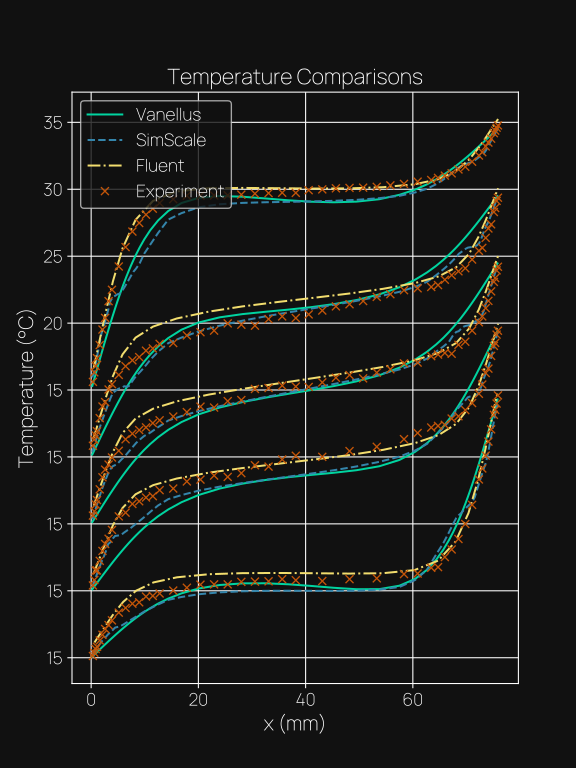
As expected the temperature profile rises from 15°C at the cold wall on the left to 34.6°C at the hot wall on the right. In the center of the cavity the shear flow generates a turbulent region where the temperature gradient is reduced in comparison to at the walls.
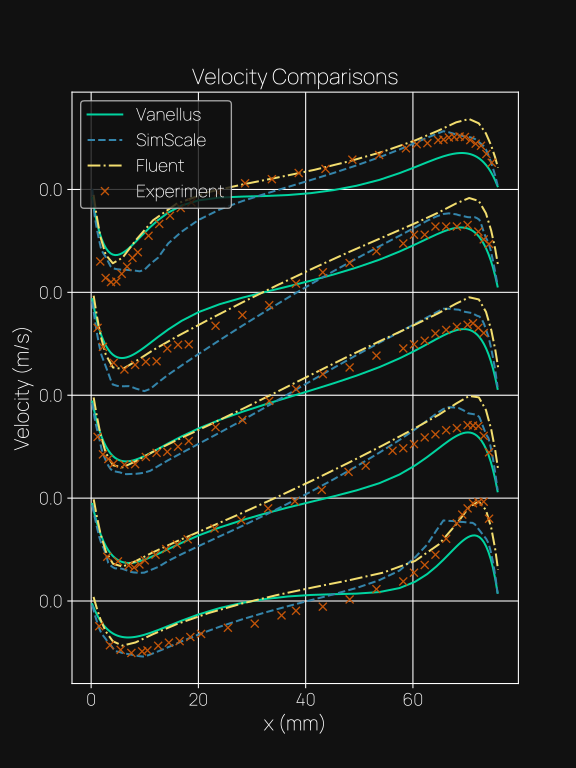
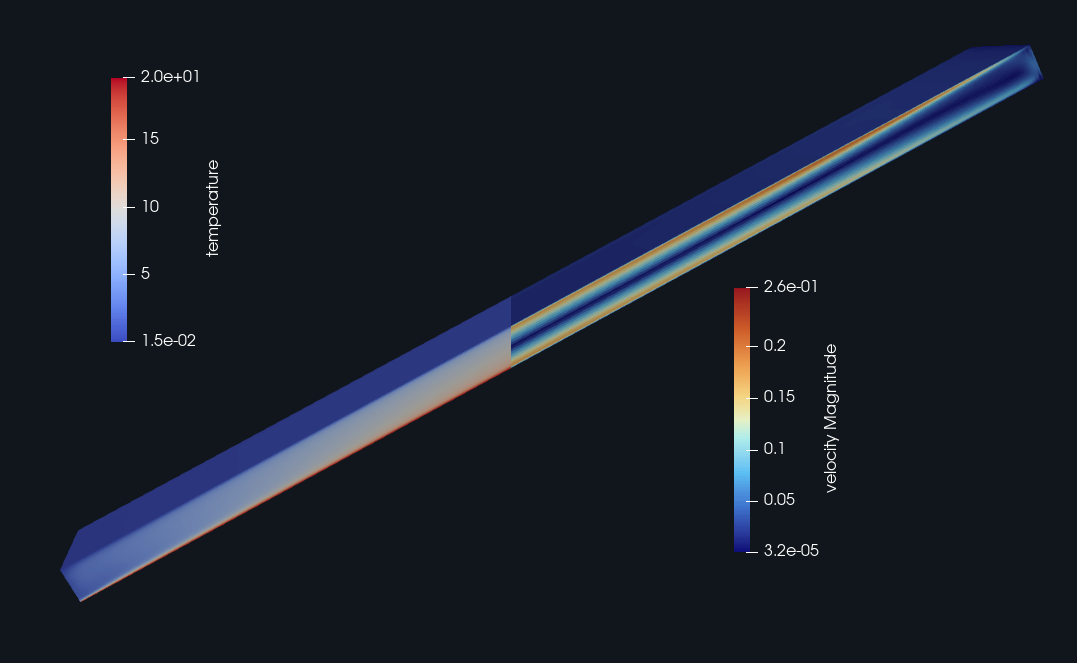
From the velocity profiles we can clearly see the development of the circulation cell: cold air descends on the left (upper surface in the image below) and hot air rises on the right (lower surface), as can be seen in a visualization of the flow field below.
The graphs show that the Vanellus solver performs similarly to the other two commercial solvers when compared to the experimental data. No single solver matches the data perfectly, and each one agrees better in some regions than in others.
Solver Performance
For this benchmark, we used our in-house automated rectilinear meshing pipeline to generate a finer mesh near the heated walls where the air moves fastest as it circulates around the cavity.
Although the unstructured SimScale mesh uses fewer cells (around 3.1M vs 3.8M for our rectilinear mesh), our GPU-accelerated solver takes only 4 minutes on an NVIDIA RTX Pro 6000 Blackwell minutes vs 128 minutes (or 70 core-hours) for SimScale's CPU-bound solver. The Fluent study did not report their runtimes.
Conclusion
By comparing against both experimental and industry-standard CFD values, we have proven the accuracy of our CHT modeling tool in a prototypical natural convection scenario. We showed that it performs equally well to two other commercial products in terms of accuracy, while providing significant performance improvements in terms of runtime.
References
- Betts, P.L. & Bokhari, I.H. "Experiments on turbulent natural convection in an enclosed tall cavity", Int. J. Heat & Fluid Flow 2000, Vol 21, pp 675-683. https://doi.org/10.1016/S0142-727X(00)00033-3
- SimScale, "Natural Convection: Buoyant Flow Between Heated Plates", https://www.simscale.com/docs/validation-cases/buoyant-flow-natural-convection-between-heated-plates/
- Zhang, Z., Zhang, W., Zhai, Z. J., & Chen, Q. Y. "Evaluation of Various Turbulence Models in Predicting Airflow and Turbulence in Enclosed Environments by CFD: Part 2—Comparison with Experimental Data from Literature", HVAC&R Research 2007, 13(6), 871–886. https://doi.org/10.1080/10789669.2007.10391460